How do you recognize travel stress in your dog in the car? Early signals, how it differs from excitement, and how Voicari brings more clarity.
Recognizing travel stress in dogs: how do I spot it before it is too late?
For most dogs, travel stress does not start with a single dramatic moment but with small, easily missed signals: increased panting without physical exertion, frequent lip licking, yawning when not tired, or restlessness the moment they get in the car. If you can recognize and interpret these early signals, you can respond before they escalate into vomiting, escape attempts, or aggressive behavior during the drive.
The trunk is packed, the towels are ready, and in an hour the drive to your summer vacation begins. Your dog is standing next to the open trunk, panting, even though it is still cool and he has barely moved. His gaze flicks back and forth between you and the open car door. Is that excitement? Or is something already starting here that will intensify during the drive?
This uncertainty accompanies many dog owners at the start of a trip. Not because they do not watch their dog closely enough, but because a single signal like panting does not tell you anything conclusive in that moment. And that is the core of the problem: travel stress and excitement often look alike at first glance. The difference shows not in one signal, but in how things develop over the next minutes and hours.
What is travel stress in dogs and what causes it?
Travel stress describes a physical and behavioral stress response triggered by unfamiliar motion, strange noises, changed smells, or the loss of a familiar environment. Typical triggers are the driving motion itself, the confined space in the car, loud or sudden noises, and the switch between familiar and unfamiliar surroundings at rest stops.
Not every dog reacts the same way to the same stimuli. A dog who rarely rides in the car processes the motion differently than a dog for whom car rides are part of everyday life. That does not mean travel stress is exclusively a problem of inexperienced dogs. Even seasoned travel companions can show stress signals on longer routes, in heat, or at unfamiliar destinations.
How do I recognize early signs of stress in the car?
Early signs are usually physical and quiet, not loud and unmistakable. They include:
- rapid panting without exertion or heat
- frequent licking of the nose or lips
- yawning while wide awake
- increased drooling
- trembling
- a crouched posture or attempts to make themselves as small as possible
- a sudden change in barking, higher, shorter, more repetitive than usual
In behavioral science, these signals are known as calming signals. They are forms of expression dogs originally use to defuse tension in social situations. They show up in the car because the dog is reacting to a situation he cannot end or control himself.
Is panting in the car normal for a dog or a warning sign?
A single bout of panting is not a warning sign. Panting regulates body temperature and occurs equally with warmth, excitement, and exertion. It only becomes a concern in combination. Panting at a cool temperature while at rest, together with lip licking, yawning, and a tense posture, points more toward stress than heat or joy.
A dog can be signaling stress without any single signal proving it. What matters is the combination of several signals and how they unfold over time. A dog who relaxes again after a few minutes shows a different pattern than a dog whose tension persists or increases throughout the entire drive.
Excitement or stress, what is the difference?
Excitement and travel stress differ less in the outward signal than in how it develops. A happy dog initially shows heightened arousal (panting, whining, pacing) that settles down once the new situation becomes more familiar or the drive begins. A stressed dog shows the same signals, but they persist or intensify instead of fading.
So the most important difference between excitement and stress is not the signal itself, but how it develops over time.
What can I actually do to reduce travel stress?
Short practice drives before the actual trip help your dog gradually associate the car with neutral or positive experiences, instead of linking it only to long, stressful journeys. Enough breaks with water and short walks interrupt the sensory overload of motion and noise. A familiar blanket or crate provides a stable point of reference, both in smell and sight, in an otherwise changed environment. Direct sunlight and overheating in the vehicle amplify existing stress and should be avoided.
If a dog repeatedly shows clear stress signals despite these measures, that is not a sign of poor preparation. It is a cue to adapt your approach individually with a certified dog trainer or behavior consultant.
When should I stop the drive or seek veterinary advice?
Persistent vomiting, diarrhea, very heavy and ongoing panting despite breaks, panic reactions such as escape attempts, or sustained loud barking over a longer period are signals that make it sensible to interrupt the drive. If this pattern repeats across several trips or gets worse, a veterinary check-up makes sense to distinguish physical causes such as nausea or circulatory problems from purely behavioral stress.
! This article is not a substitute for individual veterinary or behavioral-medicine advice.
How do I know whether my dog is stressed in the car when I am the one driving?
This is exactly where the real gap lies! If you are driving, you cannot watch your dog continuously, precisely in the moments when an early pattern is only just developing into a clear one. A single glance in the rearview mirror shows a snapshot, not a progression.
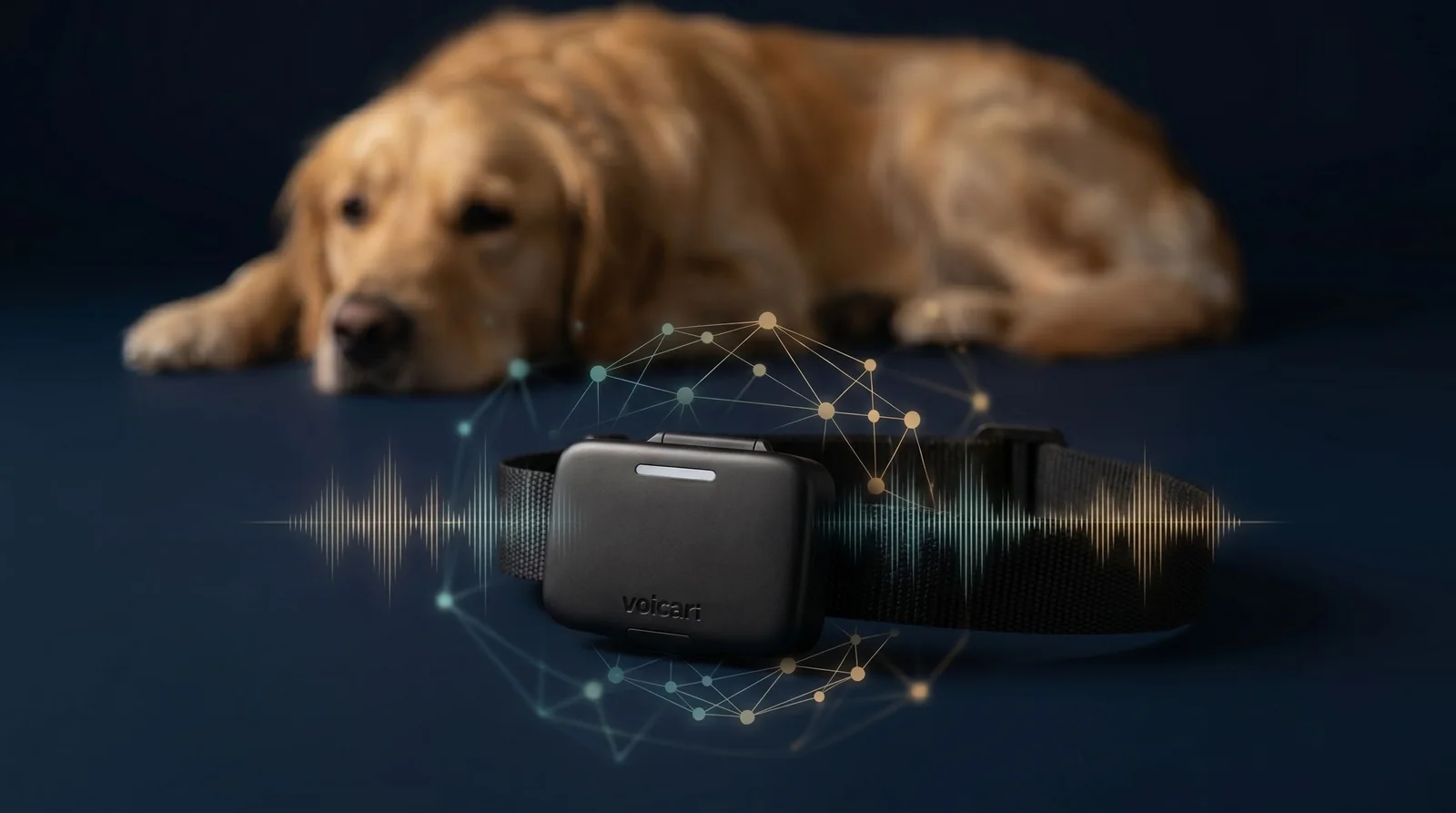
The Voicari emotion and health tracker was built to close exactly this gap, not as a training or anti-bark collar, but as an observation tool and everyday companion. It maps barking, together with heart rate, respiratory rate, and activity, to one of 24 emotional states from 7 core families grounded in affective neuroscience:
- Happiness/Play
- Curiosity/Seeking
- Care
- Calm/Neutral
- Fear
- Anger/Rage
- Sadness/Panic
The underlying model was trained on more than 1.16 million data points from more than 30,000 dogs across over 110 breeds.
Bark filtering runs directly on the collar: only recognized dog vocalizations leave the device, while ambient sound and human speech are already filtered out on the device itself. Only then does the actual emotion analysis take place on Voicari's servers. A patent application for the underlying technology was filed with the German Patent and Trademark Office (DPMA) on 27 February 2026.
A single value like heart rate does not fully explain an emotional state. Only the combination of voice, body signals, and how they develop over time produces a reliable picture. That way, the question "Was that excitement just now, or stress?" stops being pure guesswork and becomes an observation you can understand better in the context of your dog's other signals.
Frequently asked questions
Is panting in the car always a stress signal?
No. Panting regulates body temperature and also occurs with warmth or joy. It only becomes a relevant cue in combination with other signals such as lip licking, yawning, or a tense posture.
How long does it take for a dog to get used to car rides?
That varies from dog to dog and depends on prior experience, age, and trip length. Short practice drives, built up step by step before a long journey, help most dogs adjust to the situation gradually.
Can a dog suddenly react more strongly during the drive even though he was relaxed at the start?
Yes. Heat in the vehicle, longer driving time, or several rest stops can bring out tension only as the trip goes on. The start of a drive therefore says little about how the rest of it will unfold.
Is Voicari a training or anti-bark collar?
No. Voicari is not a training or anti-bark collar. It recognizes and classifies emotional states without acting on your dog's behavior in any way.
Curious what your dog is feeling?
Voicari reads vocalizations together with heart rate, respiration and activity to show you how your dog is really doing.
Discover Voicari