How Does a Wearable Recognize My Dog's Emotions? A Look Inside Our Patent Application
How Voicari reads canine emotions: on-device bark filtering, frequency-aware acoustic analysis, and vital signs, the method we filed as a patent application with the DPMA.
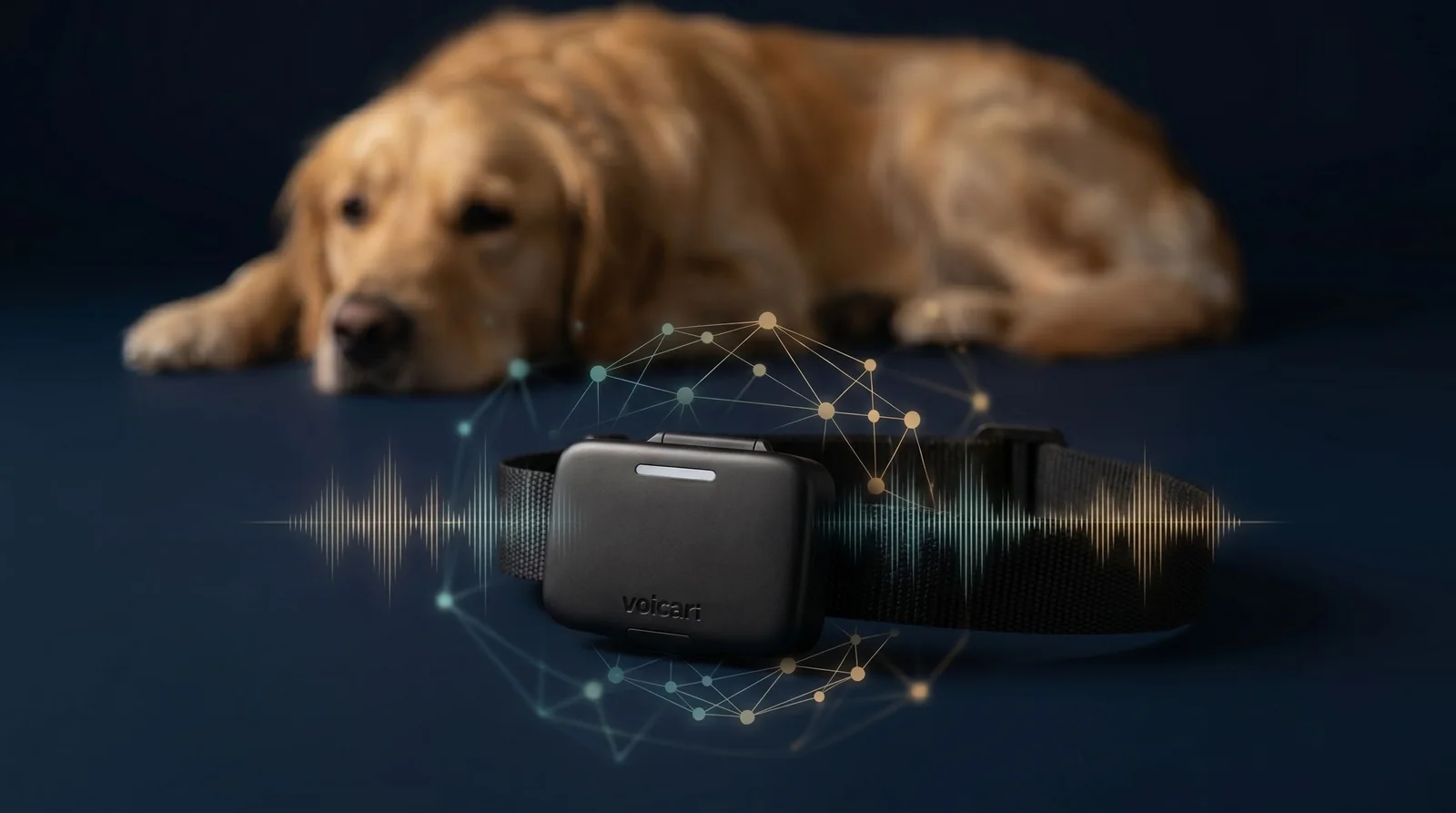
An emotion wearable for dogs does not recognize feelings by listening in on your dog. It filters, directly on the device, for the moments your dog actually makes a sound, discards everything else, and then analyzes the frequency patterns of that sound together with heart rate, respiration, and activity. This is exactly the method we filed as a patent application with the German Patent and Trademark Office (DPMA) on 27 February 2026. In this article we explain what the application says, in language that does not require a computer science degree.
How can you tell how a dog is feeling in the first place?
Dogs communicate their feelings through two channels you already know: the body (tail, ears, posture, gaze) and sounds (barking, whining, growling, howling). The body is what you see when you are there. The sounds are what remain when you are not.
The problem: not every bark is the same bark. A happy bark at the door, an alert bark at the window, and a panicked bark in an empty flat often sound similar to human ears. To an algorithm that evaluates pitch, rhythm, duration, and the distribution of energy across frequencies all at once, they differ clearly. And the body tells its own story. A racing pulse behind a calm-sounding vocalization tells a different story than the same sound on a relaxed heartbeat.
An emotion wearable like Voicari starts exactly here. It does not "listen"; it captures vocalization events and vital signs and translates them into one of 24 emotional states across 7 core emotional families.
What happens on the device before anything is analyzed?
The most important part of the method happens before a single data point leaves the wearable. Our patent application describes a two-stage filter that runs directly on the device.
- Stage 1: Loudness threshold. The microphone runs in a low-power mode and only measures the energy level of its surroundings. Only when that level crosses a threshold does a short capture start at all. Silence and quiet background noise trigger nothing.
- Stage 2: Bark detection on the chip. A small, specially compressed AI model runs in a sealed-off area of the chip that neither the app nor Voicari itself can access, and decides: bark event or not? Only what is recognized as a bark event is transmitted, encrypted, to Voicari's servers, where it is stored encrypted. Ambient noise, the TV, street sounds, and human speech are discarded on the device. Voicari does not create or store audio recordings.
The application frames this as a technical necessity: a device that records and transmits audio continuously has a dead battery within hours and produces a flood of data nobody wants to process. For you as an owner, the effect is a different one: your living room is not being listened to. Anything that is not a bark event is not analyzed, not transmitted, not stored. Not because we promise it, but because the device is built that way from the ground up. We compare this with other devices in our article Are dog trackers safe?.
How does a bark become an emotion reading?
The actual analysis starts on Voicari's servers. Simplified, four steps run in sequence, each described individually in our application.
- The sound is turned into an image. The audio signal becomes a so-called log-mel spectrogram: a representation of how much energy sits in which frequency at which moment. The mel scale is modeled on how hearing works and makes differences in the relevant frequencies easier to see.
- Interference is factored out. A technique called per-channel energy normalization (PCEN) compensates for whether your dog was closer to or further from the microphone, whether a washing machine was running in the background, or whether he was standing in an echoey kitchen. This is the difference between a model that works in the lab and one that works in your home.
- The emotionally relevant frequencies are emphasized. Our research shows that the emotional information in dog vocalizations is concentrated mainly in the lower frequencies, below roughly 4 kHz. The method therefore splits the spectrogram into a low and a high channel, analyzes the low channel at higher resolution, and down-weights the high channel. High-frequency environmental noise loses its influence.
- A deep learning model reads the sound like a sentence. The emotion model combines three building blocks. Convolutional networks (CNN) detect local patterns in the spectrogram, such as harmonic structures or abrupt changes in energy. Recurrent networks (RNN) follow how these patterns evolve over the duration of the sound. An attention mechanism then gives more weight to the segments that reveal the most about the emotion, for example the onset of a bark sequence or its loudest moment. Long vocalizations are first split into overlapping segments, each segment is evaluated on its own, and the results are merged into an overall reading.
The output is not a yes-or-no answer but a probability distribution across the emotion classes, including a confidence score.
Why is audio alone not enough?
Some emotions sound confusingly alike. Our application uses the example every dog owner knows: fear and anger. A defensive growl and an aggressive growl sit acoustically close together. What separates them is often the body.
That is why the method processes, alongside the audio signal, the vital signs the wearable measures: heart rate, respiration, movement, and activity. Add to that your dog's profile data such as age, breed, and size. A multimodal interpreter brings all of this together and can correct a decision in favor of the more likely emotion. A Chihuahua and a Great Dane bark in different frequency ranges, and what counts as an excited pulse for one is a resting state for the other. These vital signs are wellness signals used to read emotion, not a medical diagnosis.
Which emotions can the wearable distinguish?
The model assigns vocalizations to 7 core emotional families grounded in affective neuroscience: Happiness/Play, Curiosity/Seeking, Care, Calm/Neutral, Fear, Anger/Rage, and Sadness/Panic/Grief. Within these families, Voicari distinguishes 24 emotional states.
This taxonomy is inspired by research on primary emotion systems in mammals (known above all through Jaak Panksepp), adapted for the practical classification of dog vocalizations.
The model is trained on data points from over 30,000 dogs across more than 110 breeds. The behavioral labels come from our work with behavioral-labeling partners and an advisory board of veterinarians and canine behavior experts. You can find the details on our research page.
See how the Voicari device works in detail on the Voicari Series 1.0 page.
What exactly did we file for patent?
The patent application was filed with the German Patent and Trademark Office (DPMA) on 27 February 2026 under application number 10 2026 108 261.0. It comprises 22 claims and a 45-page description. What we are seeking to protect is the method as a whole: the sensing on the dog, the two-stage filtering on the device, the frequency-aware analysis on the server, the multimodal fusion with vital signs, and the training of the underlying AI model.
Building on this German filing, we have filed the same invention in further markets:
- European Patent Office (EPO): application 26175404.8, filed 29 April 2026
- Australia (IP Australia): application 2026203553, filed 8 May 2026
- United States (USPTO): application 19/695,633, filed 2 June 2026
All of these are patent applications and are patent-pending.
What does this mean for you as a dog owner?
In practical terms: when your dog barks while home alone, the app does not just show "barked". It shows an assessment of whether that barking sounded more like excitement, curiosity, or fear, when it started, and how long it lasted. Over days and weeks, this builds a picture you would never get with your ears alone. For genuine health concerns, though, the wearable is not a substitute for your vet, so always see a veterinarian when something worries you.
Voicari Series 1.0 is currently available for pre-order as a founding member, with a limited number of places. The first devices are scheduled to ship from October 2026. Designed and developed in Berlin, GDPR-compliant. We Speak Dog.
Frequently asked questions
Does Voicari listen in on my home? No. The microphone initially measures only the loudness level. A short capture starts only when a threshold is crossed, and an AI model directly on the device checks whether it is a bark event. Only recognized bark events leave the device. Speech and ambient noise are discarded on the device. You can pause detection in the app at any time.
Has Voicari filed a patent? Voicari filed a patent application with the DPMA on 27 February 2026 (application number 10 2026 108 261.0) and has filed follow-on applications in Europe, the United States, and Australia. These are patent applications and are patent-pending.
Does emotion recognition work for every breed? The model is trained on data from more than 30,000 dogs across over 110 breeds and factors profile data such as breed, age, and size into the analysis. Voicari Series 1.0 is designed for dogs from 15 kg.
Where do the emotion categories come from? The 7 core families are grounded in affective neuroscience and research on primary emotion systems in mammals. They have been adapted for the practical classification of dog vocalizations.
Curious what your dog is feeling?
Voicari reads vocalizations together with heart rate, respiration and activity to show you how your dog is really doing.
Discover Voicari