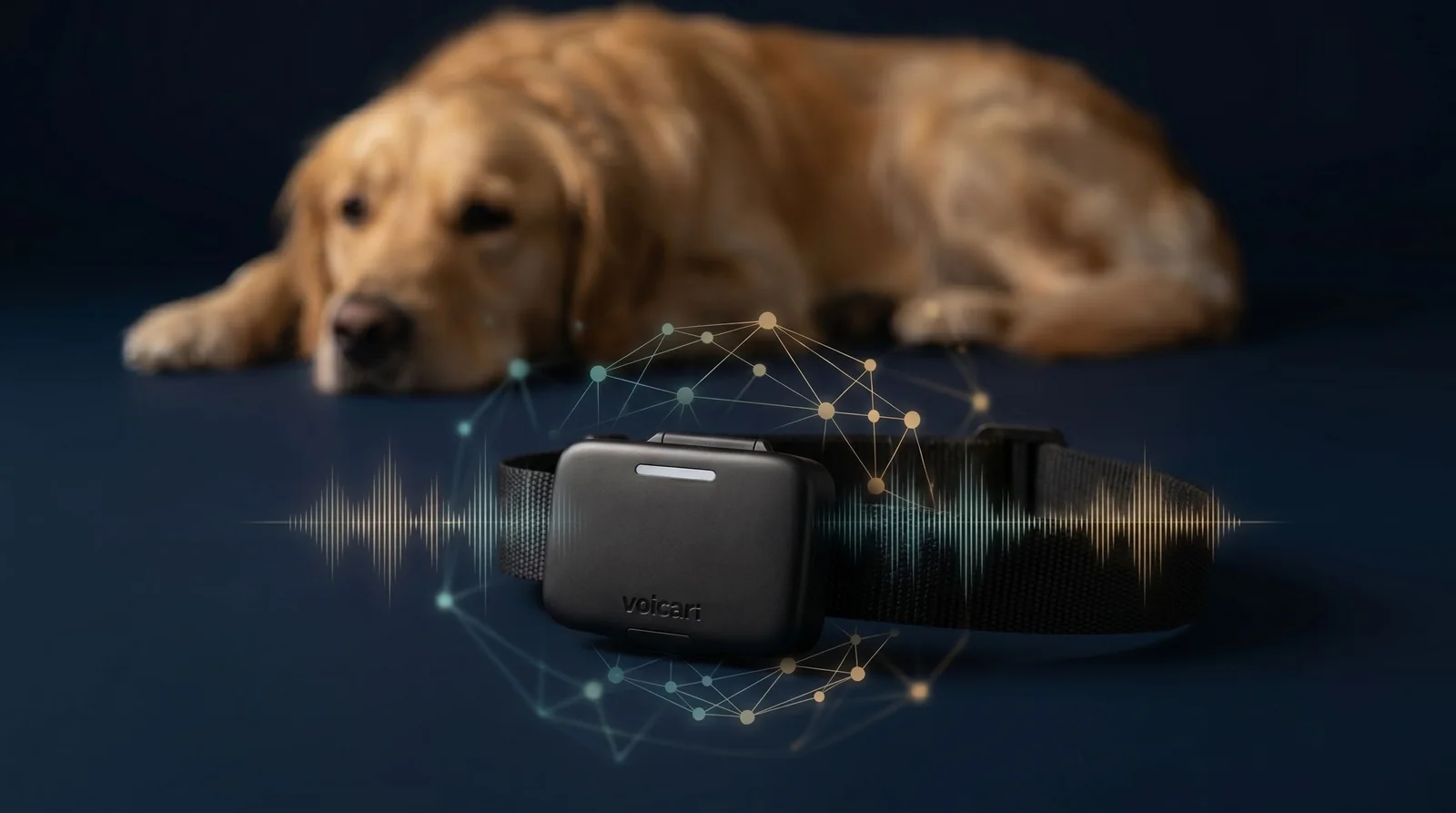
What does my dog really feel? Why heart rate, barking, and behavior only tell the full story together, explained by science and without the myths.
Your dog pants, its heart beats faster, it barks differently than usual. Is that joy, exertion, or fear? A single signal will not tell you. Only the interplay of three things gives you a reliable picture: what research knows about basic emotions in animals, what body signals like heart rate and respiration show, and how your dog is behaving and expressing itself right now, for example through barking. Each of these three on its own is only a hint, not proof.
This is more than dry theory. In everyday life, exactly this gets missed all the time. A faster pulse, a change in barking, or an unusual body posture is often attributed too quickly to a single cause, even though the same signal can have very different reasons behind it.
Are there basic emotions that work the same way in dogs as in humans?
Research assumes that mammals carry a limited number of basic emotions in the brain, anchored in the same brain regions regardless of the species. The neuroscientist Jaak Panksepp described seven such core systems: curiosity and expectation, rage, fear, care, separation distress, play, and a mating system that plays no role for pets in this context. He studied this in part by applying targeted stimuli to the brain and observing their effect on behavior. Exactly how well this model transfers to each individual species is still debated in research.
Voicari draws on this framework but adapts it for the everyday life of dogs: 7 core emotional families, namely Happiness/Play, Curiosity/Seeking, Care, Calm/Neutral, Fear, Anger/Rage, and Sadness/Panic/Grief. This is not a one-to-one copy of the original system, but an adaptation, among other things to capture a calm baseline state that your dog shows most of the time.
What does heart rate reveal about your dog's emotional state?
Heart rate and the variation between individual heartbeats are considered a recognized, non-invasive indicator of the nervous system that automatically regulates pulse and breathing. When a dog is stressed or excited, the heart beats faster and the variation between beats becomes more even. As the dog calms down, this pattern reverses. Respiratory rate is closely linked to this and changes in a similar way.
Cortisol is traditionally regarded as a stress marker, but it can only be measured through a saliva or blood sample, a snapshot rather than continuous observation. That is why research into the wellbeing of dogs increasingly focuses on what can be measured continuously and without intervention, above all heart rate, its variation, and activity.
Why isn't heart rate alone enough?
A faster pulse can mean exertion, excitement, fear, or pain, and on its own it does not tell you which of these applies. Your dog can show a very similar pulse after a walk and in a fearful situation, even though it is truly feeling something completely different.
Only the comparison with other signals makes the difference visible, above all with the activity level. A faster heartbeat without accompanying movement means something different than the same increase in the middle of an intense walk.
This is exactly where Voicari comes in, an AI-powered smart wearable that connects heart rate with further signals instead of looking at it in isolation.
More on the technology and data behind the emotion wearable
What does barking reveal about your dog's emotional state?
Barking is not a uniform signal with a fixed meaning. It changes audibly depending on the situation. Research, including work by Péter Pongrácz and colleagues, shows that short pauses between individual barks tend to occur in tense, aggressively charged situations, while longer pauses at a higher pitch tend to occur during play. Test participants, working from audio recordings alone and without seeing the situation, could guess significantly better than chance whether a dog was alarmed, wanted to play, or was suffering from separation stress.
Domestic dogs also bark in more situations and more often than wolves, presumably because barking became an important means of communication between dog and human over the course of domestication. Even so, the same holds here: the sound alone is a hint, not proof, because every dog brings its own vocal way of expressing itself.
Why does your dog often show a different picture at the vet than at home?
Studies of dogs' heart rate during a routine veterinary examination show that the pulse changes noticeably over the course of the appointment, an effect that is mainly due to the unfamiliar environment, not the actual state of health. A single examination therefore often does not show how relaxed or tense your dog usually is.
Readings from the familiar home environment, where most dogs are noticeably more relaxed, can fill in this blind spot. They do not replace the veterinary examination, but they provide additional context about your dog's usual baseline outside the clinic.
How does Voicari bring these three kinds of signals together?
The Voicari device brings vocalization, heart rate, respiration, and activity together in one model and assigns them to one of 24 emotional states drawn from the 7 core families named above. The model was trained on more than 1.16 million data points from over 30,000 dogs across more than 110 breeds.
Vocalization filtering runs directly on the wearable: only recognized vocalization events leave the device, while ambient sounds and human speech are discarded on the device itself. Only then does the actual emotion analysis take place on Voicari servers. For the underlying technology, a patent application was filed with the German Patent and Trademark Office (DPMA) on 27 February 2026.
Important for context: the Voicari device does not make a diagnosis. It makes continuously captured signals visible and can alert you to changes, but it does not replace a veterinary examination or behavioral-medical diagnosis in an individual case. It is also not a training or anti-bark collar and does not act on your dog's behavior.
You can find all the details on the 24 states and the underlying data at voicari.com/research.
Frequently asked questions
Is a faster pulse in a dog always a sign of stress? No. A faster pulse can mean exertion, excitement, fear, or pain. Without further context, such as how active your dog is right now, the cause cannot be determined with certainty.
Why is cortisol often not enough as a stress marker in everyday life? Because a cortisol measurement requires a saliva or blood sample and provides only a snapshot. For ongoing observation in everyday life, values like heart rate and activity are better suited, because they can be captured continuously and without intervention.
Does more frequent or changed barking automatically mean there is a problem? No. What matters are the triggers, the duration, and the accompanying behavior, and whether the barking has changed compared to your dog's previous behavior. A precise assessment belongs in the hands of a veterinarian or a certified behavior consultant.
Does continuous monitoring replace a visit to the vet? No. Continuously captured values provide additional context, for example about your dog's usual baseline, but they do not replace a veterinary examination or diagnosis.
Is the Voicari device a training or anti-bark collar? No. It is not a training or anti-bark collar and does not act on your dog's behavior. It recognizes and classifies emotional states.
Curious what your dog is feeling?
Voicari reads vocalizations together with heart rate, respiration and activity to show you how your dog is really doing.
Discover Voicari