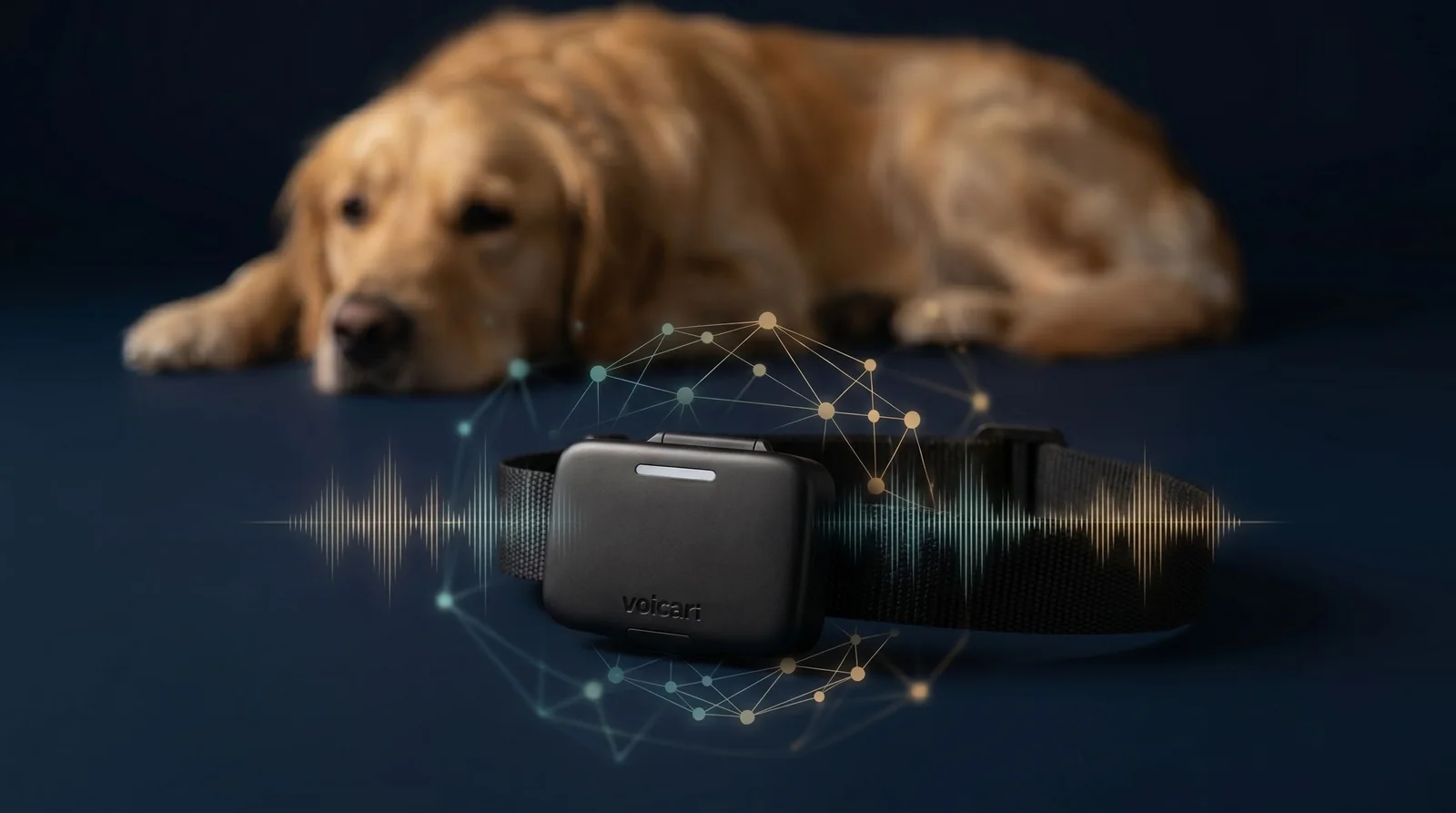
Translating barks with an app: gimmick or science? What is actually possible today, and how Voicari translates emotions instead of words.
Almost every dog owner has typed "dog translator" into the app store at some point. Usually late at night, after an especially insistent round of barking, quietly hoping for a clear answer at last. This article gives an honest picture of what you actually get, what is scientifically possible today, and how to recognize a serious approach, including ours.
What can dog translator apps really do?
Most of these apps are entertainment, not information. A typical pattern: the microphone detects a volume level or a rough frequency. The app then picks one of a handful of pre-written phrases, "I want to play" or "I am hungry", regardless of what is actually happening in the moment. Some apps show an animation or an emoji instead.
That can be fun, and as a bit of a gimmick it is perfectly fine. What it does not deliver is reliable information about what your dog is feeling or needs right now. The same randomly selected phrase can pop up in completely different situations.
What is scientifically possible when it comes to translating barks?
Vocalizations carry real emotional information. Behavioral research has shown for years that acoustic features such as pitch, timbre and the gaps between individual sounds differ measurably depending on whether a dog is playing, alarmed or under stress. People can even sort these differences roughly without any training.
This information only becomes truly meaningful, however, once it is combined with body signals such as heart rate, respiration and activity, along with the context of the situation. A single bark without that context stays ambiguous.
The distinction matters: emotion recognition is real and scientifically grounded. A word-for-word translation of dog sounds into human language is not. Dogs do not communicate in a vocabulary that maps one to one onto ours. Barking, whining and growling carry emotional state and urgency, not grammatically structured sentences. Any product that promises a literal translation, "I would like to go outside now", goes beyond what current research supports.
How do I recognize a serious dog translator?
Here is an honest checklist you can apply to any product in this space, including ours:
- A named, traceable dataset, not just the claim that one exists, ideally with concrete numbers on dogs and breeds
- Expert labeling of the data by professionals, not purely automated or crowdsourced without expert oversight
- A recognizable scientific foundation, for example affective neuroscience, rather than a purely proprietary black box
- Honest statements about the limits of the method, instead of promising a full translation into human language
If any one of these is completely missing, extra caution is warranted. A serious provider should be able to answer each of these four questions concretely and without dodging. We show you how we do it in the next section.
How does Voicari translate vocalizations into emotions?
Voicari is a canine emotion wearable. It does not translate words, it translates emotional states: Voicari Series 1.0 maps vocalizations, together with heart rate, respiration and activity, to one of 24 emotional states across 7 core emotional families, based on affective neuroscience. This happens through a wearable your dog wears throughout the day. The underlying model was trained on more than 1.16 million data points from over 30,000 dogs across more than 110 breeds.
Bark filtering runs directly on the device. Only recognized bark events leave the wearable. Ambient sound and human speech are discarded on the device. Only after that does the actual emotion analysis take place on Voicari servers. For the underlying technology, a patent application was filed with the German Patent and Trademark Office (DPMA) on 27 February 2026.
How do I get answers I can understand instead of just raw data?
A list of 24 possible states is not, on its own, an answer to your real question: "How was my dog really doing today?" That is exactly what PetGPT is for, the chat companion in the Voicari app. PetGPT reads your dog's data with you and responds in a short, easy to follow exchange, based on heart rate, activity and the recognized emotional state. That is the real translation. Not word for word, but your question turned into an answer you understand right away.
Two things matter to us here: Voicari is not a training, anti-bark or deterrent collar. It listens and interprets, it does not correct. And it does not make a medical diagnosis. Heart rate and respiration are wellness insights. For health or behavioral concerns, the right path remains a veterinarian or a certified behavior consultant.
If you want to know what your dog feels, instead of guessing what they are "saying": We Speak Dog.
Frequently asked questions
Is there a real dog translator?
Not in the sense of a word-for-word translation. What does exist is scientifically grounded emotion recognition that maps vocalizations, together with body signals, to an emotional state. That is something different from a language translation.
Are dog translator apps any good?
Most are pure entertainment. They play random sounds or phrases in response to a detected bark, without any traceable dataset or scientific method behind them.
Can AI translate barking?
AI can map barking, together with further signals such as heart rate and activity, to an emotional state, if it has been trained on a real, expert-labeled dataset. It does not produce a translation into specific words or sentences.
Why can't dogs simply be translated in full sentences?
Because dogs do not communicate in a vocabulary that maps one to one onto human language. Their vocalizations carry emotional state and urgency, not grammatically structured statements. That is why any literal translation stays a simplification that goes beyond what the data supports.
What makes Voicari different?
Voicari names its dataset and methodology openly: more than 1.16 million data points from over 30,000 dogs across more than 110 breeds, expert-labeled and based on affective neuroscience. And Voicari explicitly does not promise a word translation, but rather classification into 24 emotional states across 7 core emotional families.
Is a dog translator a diagnosis?
No. Emotion recognition provides continuous observation and wellness insights, not a medical or behavioral-medical diagnosis. For health or behavioral concerns, the right path remains a veterinarian or a certified behavior consultant.
What is PetGPT at Voicari?
PetGPT is the chat companion in the Voicari app, not a separate device. It reads your dog's data, such as heart rate, activity and emotional state, with you and answers questions about it in a short, calm chat, instead of leaving you to interpret charts and timestamps yourself.
Curious what your dog is feeling?
Voicari reads vocalizations together with heart rate, respiration and activity to show you how your dog is really doing.
Discover Voicari